
Winning streaks in Formula One represent the highest level of dominance a driver can achieve. Unlike podium consistency, consecutive race wins require perfect execution across multiple race weekends, including qualifying pace, race strategy, tire management, and reliability.
From historic runs by Michael Schumacher to modern dominance by Max Verstappen, winning streaks define eras of superiority in Formula 1.
This page explores the longest consecutive win streaks in F1 history, along with key insights, comparisons, and trends that highlight the sport’s most dominant drivers.
#
Driver
Team
Career Streak
Season Streak
Total Wins
🥇
Red Bull
10 races
10 races (2023)
71
🥈
BMW Sauber
9 races
9 races (2013)
53
🥉
Ferrari
7 races
7 races (2004)
91
4
Williams
7 races
4 races (2016)
23
5
Mercedes
5 races
5 races (2026)
8
6
Ferrari
5 races
5 races (2014)
106
7
Aston Martin
4 races
4 races (2006)
32
8
Brawn Mercedes
4 races
4 races (2009)
15
9
McLaren Mercedes
3 races
2 races (1998)
20
10
McLaren
3 races
3 races (2025)
9
11
Ferrari
2 races
2 races (2019)
9
12
HRT
2 races
2 races (2014)
8
13
Jaguar Cosworth
2 races
2 races (1999)
4
14
Sauber
2 races
2 races (2007)
11
15
Sauber BMW
2 races
2 races (1997)
11
16
McLaren Mercedes
2 races
2 races (2005)
21
17
McLaren
2 races
2 races (2025)
13
18
Minardi
2 races
2 races (2010)
9
19
Williams BMW
2 races
2 races (2003)
6
20
Ferrari
2 races
2 races (2002)
11
21
Williams
1 races
1 races (2022)
4
22
Red Bull Renault
1 races
1 races (1995)
13
23
Haas F1 Team
1 races
1 races (2021)
1
24
Mercedes
1 races
1 races (2022)
8
25
Ferrari
1 races
1 races (2003)
3
26
Lotus Renault
1 races
1 races (2008)
1
27
Sauber Petronas
1 races
1 races (1997)
3
28
Renault
1 races
1 races (2004)
1
29
Williams BMW
1 races
1 races (2001)
7
30
Toyota
1 races
1 races (1996)
1
31
Lotus Mercedes
1 races
1 races (2012)
1
32
Alpine F1 Team
1 races
1 races (2020)
1
33
Williams Mercedes
1 races
1 races (2008)
1
34
Cadillac
1 races
1 races (2020)
6
35
Cadillac
1 races
1 races (2017)
10
All-Time Longest Winning Streaks
Top 10 Drivers by Consecutive Wins
| Rank | Driver | Longest Streak | Best Season | Total Wins |
|---|---|---|---|---|
| 1 | Max Verstappen | 10 races | 2023 | 71 |
| 2 | Sebastian Vettel | 9 races | 2013 | 53 |
| 3 | Michael Schumacher | 7 races | 2004 | 91 |
| 4 | Nico Rosberg | 7 races | 2016 | 23 |
| 5 | Lewis Hamilton | 5 races | 2014 | 105 |
| 6 | Fernando Alonso | 4 races | 2006 | 32 |
| 7 | Jenson Button | 4 races | 2009 | 15 |
| 8 | Mika Häkkinen | 3 races | 1998 | 20 |
| 9 | Oscar Piastri | 3 races | 2025 | 9 |
| 10 | Charles Leclerc | 2 races | 2019 | 8 |
Key Takeaways: F1 Winning Streaks
- Max Verstappen holds the longest win streak (10 races), achieved during Red Bull’s dominant 2023 season.
- Sebastian Vettel follows with 9 consecutive wins, one of the most dominant runs in F1 history.
- Michael Schumacher achieved 7 wins in a row, highlighting Ferrari’s peak era dominance.
- Winning streaks require perfect race execution, unlike podium streaks which allow minor errors.
- Modern F1 makes long win streaks harder due to competitive grids and strategic complexity.
Winning Streaks by Era
2000–2004: Ferrari & Schumacher Dominance
Michael Schumacher dominated with Ferrari, combining reliability and race pace to achieve multiple winning runs.
2010–2013: Red Bull & Vettel Era
Sebastian Vettel achieved a record 9-race streak in 2013, one of the most dominant seasons ever.
2014–2020: Mercedes Hybrid Era
Lewis Hamilton led the field with consistent wins, though competition limited extremely long streaks.
2021–2026: Verstappen Era
Max Verstappen set a new benchmark with a 10-race winning streak, redefining dominance in modern Formula 1.
Comparison: Greatest Winning Streaks
| Driver | Streak | Era | Key Factor |
|---|---|---|---|
| Verstappen | 10 | Modern | Car dominance + consistency |
| Vettel | 9 | 2013 | Aerodynamic advantage |
| Schumacher | 7 | 2004 | Reliability + strategy |
| Rosberg | 7 | 2016 | Momentum across seasons |
Verstappen’s streak is often considered the most impressive due to higher competition levels.
Trends in Winning Streaks
- Longer streaks typically occur during dominant team eras
- Modern regulations reduce dominance gaps
- Reliability improvements increase consistency
- Strategy and tire management now heavily influence race outcomes
Why Winning Streaks Matter
Winning streaks show:
- Peak dominance
- Mental consistency under pressure
- Team and car superiority
- Championship momentum
Drivers with long winning streaks often go on to win the championship comfortably.
Frequently Asked Questions (FAQ)
Who has the longest winning streak in F1 history?
Max Verstappen with 10 consecutive wins.
Which driver had the most dominant season?
Sebastian Vettel (2013) and Max Verstappen (2023) are among the most dominant.
Are long winning streaks common in modern F1?
No, increasing competition has made long streaks more difficult.
Do winning streaks guarantee championships?
Almost always, as consistent wins provide a significant points advantage.
Conclusion
Winning streaks remain one of the clearest indicators of dominance in Formula One. From the precision of Michael Schumacher to the modern dominance of Max Verstappen, these records define the sport’s greatest drivers.
As Formula 1 becomes more competitive, breaking these records will become increasingly difficult—making existing streaks even more legendary.
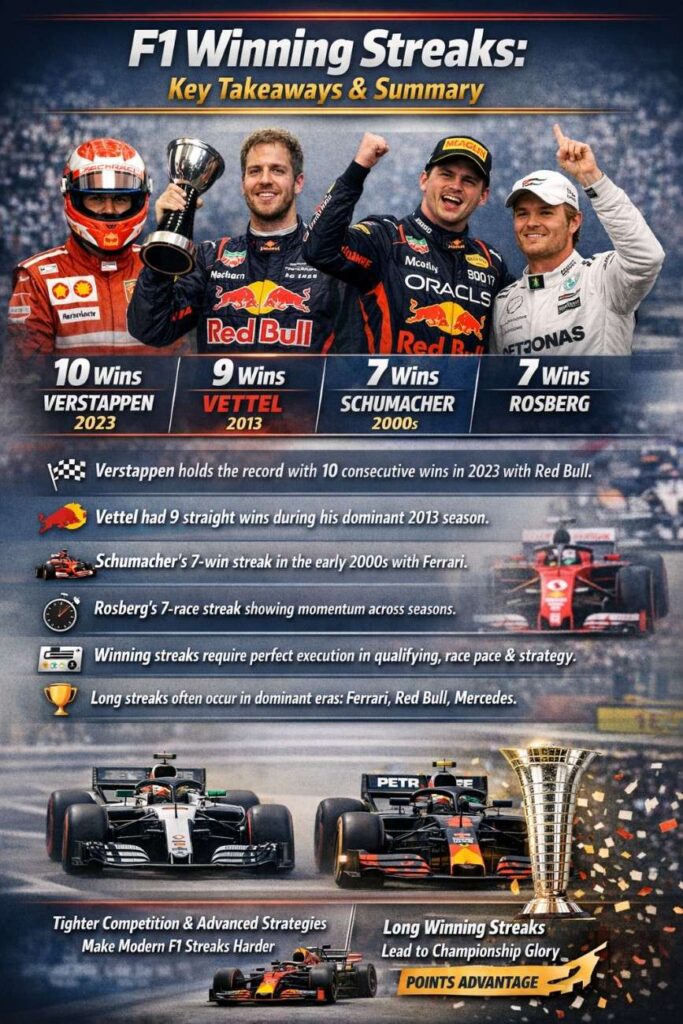
Key Takeaways & Summary: F1 Winning Streaks
- Max Verstappen holds the longest winning streak in Formula 1 history (10 races), achieved during the dominant 2023 season with Red Bull.
- Sebastian Vettel follows with 9 consecutive wins, marking one of the most dominant periods in modern F1 during 2013.
- Michael Schumacher achieved 7 wins in a row, highlighting Ferrari’s peak dominance in the early 2000s.
- Nico Rosberg also recorded a 7-race streak, showing how momentum across seasons can impact performance.
- Winning streaks represent the highest level of dominance, requiring perfect execution in qualifying, race pace, strategy, and reliability.
- Long streaks are typically seen during team dominance eras, such as Ferrari (2000s), Red Bull (2013 & 2023), and Mercedes (hybrid era).
- In modern Formula One, achieving long winning streaks is more challenging due to tighter competition and advanced race strategies.
- Drivers with long winning streaks almost always become championship contenders or winners, as consistent victories provide a significant points advantage.
F1 Stats Last Updated: September 30, 2026 | All statistics, lap times, and driver comparisons on this page reflect the most current data available from the official F1 sources. And updated till the last race which happened in 30 SEP 2026