
The 2026 Formula 1 season has ushered in a visceral, frantic energy that transcends mere mechanical evolution. It is the sound of a generational tectonic plate shifting, where the visceral scream of the internal combustion engine is now secondary to the high-frequency whine of a digital-first approach to kinetic energy recovery and corner entry. In this new era, the margin between legendary status and a P12 exit has never been thinner, defined by hyper-specific tire temperature windows and a volatility in the aerodynamic map that punishes even a millisecond of hesitation.
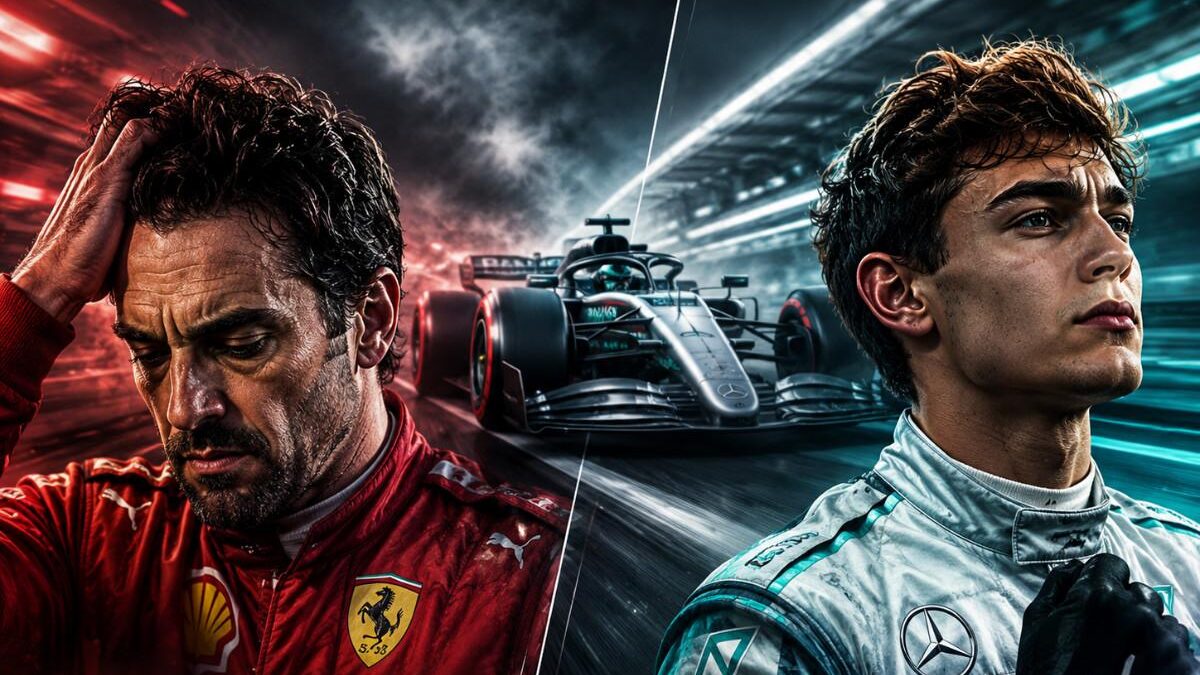
The visual contrast trackside is jarring. In one corner of the paddock, we see Lewis Hamilton “ringing the neck” of a scarlet Ferrari, fighting a machine that seems to fundamentally resist his legendary late-braking aggression. Contrast this with the clinical, low-vibration efficiency of George Russell or the “phenom” energy of Kimi Antonelli. Where the veterans wrestle, the younger generation flows, inhabiting a narrow mechanical window that requires a digital-native precision. This is the “human ghost in the machine” for 2026: a sport where experience was once a shield, but is now frequently a weight.
In a season governed by “point-and-shoot grip,” the old guard is discovering that the “feel” they spent decades cultivating is being neutralized by the sheer physics of the new regulations. The paddock is no longer just a race track; it is a psychological pressure cooker where the difference between a hero and a spectator is often measured in thousandths.
The Silver Shadow — Russell, Antonelli, and the New Mercedes Hegemony
The Canadian Grand Prix qualifying served as a definitive, albeit painful, statement for the Silver Arrows. Mercedes secured a front-row lockout, but the internal narrative was anything but settled. George Russell, clawing his way back after a bruising weekend in Miami, secured a “sprint pole” that felt like a survival instinct manifest. However, the victory was precarious, shadowed by the teenage championship leader, Kimi Antonelli, who cut the beam a mere 0.06s behind him.
The pressure on Russell is no longer merely about defeating the Red Bulls or McLarens; it is the internal erosion of his status as the team’s North Star. Toto Wolff’s reaction a smile that “says everything” is a double-edged sword. It signals Mercedes’ return to the summit, but it also validates the driver who is currently leading the championship against Russell. When the sprint race begins, Russell will sit only eight meters ahead of the phenom sharing his garage.
The “pain” here is existential. Russell is “back in the fight,” but he has returned to find the frontline has moved inside his own team. In the 2026 Mercedes, the most dangerous threat isn’t the car in the mirror; it’s the data trace from the sister car that shows a teenager finding rotation where the veteran finds resistance.
Takeaway: The Mercedes internal battle is the most dangerous on the grid because it pits the hunger of a championship leader against the survival instincts of an established star.
The Weight of the Scarlet Suit — Hamilton’s Ferrari Paradox
Lewis Hamilton’s transition to Ferrari has become a study in friction. Across Miami and Canada, the seven-time champion has struggled to reconcile a career’s worth of aggressive instincts with a car that demands surgical temperance. In Miami, the “grip faded” from his Ferrari far too early, leaving him a tenth slower than the benchmark and exposing a vulnerability in managing the car’s thermal degradation.
In Canada, the struggle became a visual tragedy. Hamilton was seen “flicking the rear out like the early days,” a nostalgic sight for the grandstands but a technical disaster for the stopwatch. He was repeatedly “deep into the hairpin,” over-rotating the car and clobbering the curbs in a desperate search for a rotation that the car simply would not grant without a massive penalty to exit speed.
“Hamilton was deep into the hairpin… that was him waving goodbye to a good exit by just having to do too much cornering too late.”
Despite his peerless race-winning experience, Hamilton is finding himself out-qualified by the sheer “point-and-shoot” simplicity utilized by younger rivals. The supernatural speed he once commanded is being throttled by a car that refuses to be bullied, leaving a legend to fight for scraps in the mid-pack while his younger counterparts exploit the tire window with ease.
The McLaren Counter-Strike — Lando Norris and the End of the Monopoly
The Miami Sprint Qualifying marked the moment the Mercedes monopoly finally cracked. Lando Norris delivered a “statement lap” that displaced Mercedes from P1 for the first time in the 2026 season. While the Silver Arrows looked “on the back foot,” the McLaren displayed a terrifying “point-and-shoot grip,” allowing Norris to attack the middle sector with a violence his rivals couldn’t match.
The collapse of the status quo was absolute. Even Max Verstappen, the former hegemon, found himself in P5, salvaging the position only through a “superb final sector” that masked a lack of pace in the first two.
The Miami Hierarchy:
- Lando Norris (McLaren) – The New Benchmark
- Kimi Antonelli (Mercedes) – The Persistent Threat
- Oscar Piastri (McLaren) – The Clinical Enforcer
- Charles Leclerc (Ferrari) – The Lone Scrapper
- Max Verstappen (Red Bull) – The Struggling Titan
This hierarchy proves that the 2026 regulations reward teams that can lock tire temperatures into a perfect window for a single “magic” lap. Mercedes, once the undisputed kings of the new era, now find themselves vulnerable to a McLaren team that has mastered the art of mechanical traction and aerodynamic stability.
The Rookie Hunger Games — Colapinto, Lindblad, and the Fight for P10
The mid-grid has become a psychological graveyard where a thousandth of a second determines the trajectory of a career. Franco Colapinto’s performance in Canada “joint best qualifying” ended in heartbreak as he missed SQ3 by just a tenth of a second. This “information overload” era means that one minor lock-up is no longer just a mistake; it is a career-stalling event.
The rookie surge, led by Arvid Lindblad “popping up on the times” ahead of world champions, is forcing veterans into uncharacteristic, desperate errors. Fernando Alonso’s disaster in Canada was the ultimate case study: attempting to “hustle” the Aston Martin with “supernatural speed,” he suffered a massive front lock-up and found the barriers. The veteran’s instinct to “override” a slow car has become a liability in 2026; the car no longer wants to be hustled—it wants to be managed.
This pressure is felt everywhere. From Pierre Gasly being “in trouble” despite his trademark consistency at Alpine, to Oliver Bearman’s surprise exit in SQ1, the message is clear: the mid-grid is a meat grinder. Technical upgrades, like those seen at Williams, have leveled the playing field to such an extent that raw, youthful aggression is now a viable, and often superior, substitute for veteran patience.
The Human Cost of 0.001 Seconds
The 2026 season has proven that technical data only tells half the story of the human cost. While Williams celebrates upgrades that “actually work” in Miami and Canada, the psychological fatigue on the drivers is palpable. We are in an era where the car’s “point-and-shoot” aerodynamics dictate terms to the driver, rather than the other way around.
Even Carlos Sainz, a driver noted for his technical intellect, admitted he only started “enjoying life” in the 2026 car after “intense technical refinement.” He used every ounce of his race-winning experience to scrape into the top 10 by a mere 0.04s—a margin so thin it suggests that even the most talented veterans are living on borrowed time.
In an era where a tire window can be slammed shut by a 0.001-second delay, is the “veteran instinct” just another word for “obsolete lag”? In 2026, the only thing faster than the cars is the rate at which the old guard is being forced to adapt—or face the exit.
The era of dominance is over; the era of the razor’s edge has begun.
FAQ Section
Q1: Why is Lewis Hamilton struggling in F1 2026? Hamilton’s aggressive late-braking style — built over two decades — directly conflicts with the 2026 Ferrari’s demand for surgical, smooth inputs. The new “point-and-shoot” aerodynamics punish over-rotation and late corner entry, which is exactly Hamilton’s natural instinct. The car refuses to be bullied, and that’s Hamilton’s biggest problem.
Q2: Who is leading the F1 2026 Championship? Kimi Antonelli (Mercedes) is currently leading the 2026 F1 Drivers’ Championship — a remarkable feat for a teenager in only his first full season, putting enormous internal pressure on teammate George Russell.
Q3: What are the F1 2026 regulations and why do they change everything? The 2026 regulations introduced a radical shift in aerodynamic philosophy and kinetic energy recovery systems. Cars now reward “point-and-shoot grip” — precise, mechanical corner entry — over the flowing, feel-based driving style that veterans like Hamilton and Alonso mastered over their careers. Tire temperature windows are hyper-specific, and the margin for error is near zero.
Q4: Is Lando Norris a championship contender in 2026? Absolutely. Norris proved in Miami Sprint Qualifying that McLaren has cracked the 2026 tire window better than anyone. His “statement lap” broke Mercedes’ early-season monopoly and confirmed McLaren as a genuine title threat alongside the Silver Arrows.
Q5: Are rookies outperforming veterans in F1 2026? In many cases, yes. Arvid Lindblad and Kimi Antonelli are outpacing world champions in qualifying trim. The 2026 car rewards digital-native precision over experience-based feel — which means rookies unburdened by old habits are adapting faster than established stars.
Key Takeaways
- Hamilton vs Ferrari is the season’s most painful subplot a seven-time champion fighting a machine that rejects his greatest strengths
- Antonelli vs Russell inside Mercedes is the most dangerous internal battle on the grid a teenage championship leader vs an established star in the same garage
- McLaren has arrived — Norris broke the Mercedes monopoly and the papaya threat is real, consistent, and growing
- Rookies are the new threat — In 2026, youth + adaptability > experience + instinct
- The mid-grid is a meat grinder — 0.001 seconds separates careers from oblivion; Colapinto, Alonso, and Gasly all felt it
- Veteran instinct is becoming a liability — The cars want to be managed, not hustled
Summary
The 2026 Formula 1 season is not just a new chapter — it is a full rewrite of who belongs at the front.
The regulations have flipped the sport’s fundamental power dynamic. Where experience and feel once separated champions from the field, the 2026 machinery demands something different: calm precision, digital-native adaptability, and the willingness to let the car dictate not the driver.
Lewis Hamilton, the greatest of his generation, is visibly wrestling with this reality at Ferrari. George Russell is fighting not just the field, but his own teenage teammate for relevance inside Mercedes. Fernando Alonso found the barriers instead of the apex. Meanwhile, Kimi Antonelli leads a World Championship in his debut season, Lando Norris has shattered the early-season order, and rookies like Arvid Lindblad are making world champions look slow.
The 2026 grid has a brutal message for the old guard: adapt or exit.
The era of dominance is over. The era of the razor’s edge where 0.001 seconds decides everything has well and truly begun. And in this new world, the youngest and hungriest are winning.
Discover Popular Updates :-
I Built a Formula 1 Car in My Garage The 5 Surprising Lessons from a 10-Year Obsession
Antonelli vs Verstappen: Who Really Won 2026 Miami Qualifying?
Norris Topples Mercedes in High-Stakes Miami Sprint Qualifying
F1 Stats Last Updated: May 3, 2026 | All statistics, lap times, and driver comparisons on this page reflect the most current data available from the official F1 sources. And updated till the last race which happened in 3 May 2026