
The 2026 season represents far more than a typical revision of the rulebook; it is a genuine reset of the Formula 1 hierarchy. While the 2024 and 2025 seasons saw clear front-runners established on track, the 2026 regulations have functioned as a strategic vacuum, sucking in global automotive giants like Audi and Ford while forcing established players to rethink their very identities. In this paddock, we often say that momentum is everything, but 2026 is “anyone’s year”—a clean slate where the technical debt of the past is wiped clean and the quest for a new “silver bullet” begins.
The Alpine Identity Crisis: A Pragmatic Admission of Failure
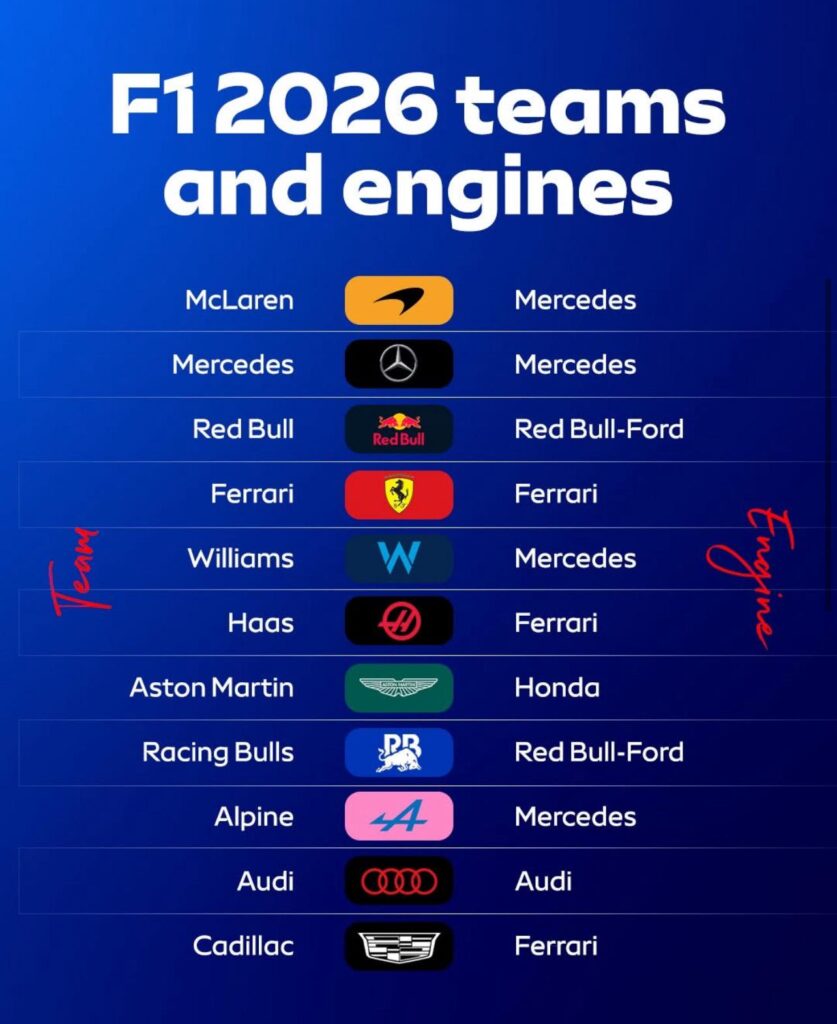
The most jarring shift on the 2026 grid is the white flag waved by Alpine. In a stunning admission of internal failure, the French outfit is abandoning its status as a full works manufacturer to become a Mercedes customer. To the purists, it is a bitter pill: a team that serves as a billboard for a historic French marque will now be designed in Britain and powered by German engineering. As one paddock wag put it:
“A French car with a German engine, as if Alpine didn’t have enough self loathing already.”
From a strategist’s perspective, however, the move is cold, hard logic. Renault has arguably produced the worst engines on the grid for 11 years running. By contrast, Alpine has watched McLaren prove that the “customer” label is no longer a ceiling; McLaren’s reunion with Mercedes led directly to championship titles in 2024 and 2025. Alpine isn’t just buying an engine; they are buying the reliability and performance that their own parent company failed to provide for over a decade.
Red Bull’s Evolution: The Manufacturer Gamble
Red Bull Racing is attempting the most audacious pivot in modern F1 history. Having spent years as Honda’s “works” partner, they are transitioning into a full-fledged manufacturer through Red Bull Powertrains (RBPT). This isn’t just a rebranding exercise; it is a massive industrial undertaking.
By partnering with Ford—marking the American giant’s first return to the grid since the 2004 Jordan supply—the team will compete under the “Red Bull RBPT Ford” banner. For Red Bull, this is about total autonomy. They are no longer beholden to the whims of a Japanese board of directors; they are now the masters of their own technical destiny. It is a high-stakes play: if they succeed, they become a Ferrari-style titan. If they fail, they risk squandering the twilight of their current era of dominance.
The 50/50 Power Split: Why the MGU-H Had to Die
The 2026 power unit overhaul is the specific “bait” that caught Audi and Ford. The removal of the MGU-H (Motor Generator Unit – Heat) was the non-negotiable “entry tax” these manufacturers demanded. The MGU-H was a marvel of engineering but lacked any meaningful road relevance and was notoriously difficult to master.
In its place, the sport has embraced a massive electrification push. The MGU-K (Motor Generator Unit – Kinetic) output will skyrocket from 160 bhp to a staggering 470 bhp. This creates a roughly 50/50 split between internal combustion and electric power. For a strategist, this shifts the tactical burden from pure aerodynamics to sophisticated battery management. The winner of 2026 won’t necessarily be the team with the most downforce, but the team that manages energy deployment and harvesting most efficiently over a race distance.
Audi’s “Deep End” Entry and Cadillac’s Long Game
The arrival of new manufacturers highlights two very different philosophies of entry. Audi has chosen the most difficult path possible, jumping into the “deep end” by committing to a full works program—building both the chassis and the power unit from day one—following their majority takeover of Sauber. It is a bold move that carries immense risk; history is littered with manufacturers who underestimated the steep learning curve of an F1 engine cycle.
In contrast, Cadillac (the 11th team) is playing a more measured hand. They will enter the grid using Ferrari engines as a “stop-gap” solution. This allows them to focus on the chassis and organizational logistics before transitioning to their own General Motors power units in 2029. It is a staged entry that prioritizes stability over the immediate “works” optics Audi is chasing.
The “Nimble” Car: The End of the DRS Era
The 2026 reset isn’t confined to the engine bay. The FIA is attempting to fix the “bloat” of modern F1 cars by mandating a more responsive, “nimble” design:
- Shorter and Narrower: Reduced wheelbases and tracks to improve agility.
- Lighter Weight: A concerted effort to reverse the trend of ever-heavier machinery.
- Active Aerodynamics: The death of the traditional DRS. In its place comes a complex system of movable wings to balance drag and downforce in real-time.
- Overtake Mode: A manual power boost that shifts the overtaking meta from “waiting for a wing to open” to strategic battery discharge.
- Safety Gains: Redesigned noses and reinforced survival cells to handle secondary impacts.
Honda’s Infinite “Final” Season
The most paradoxical story of 2026 remains Honda. In a move that defines the phrase “leaving at the peak,” Honda is officially ending its championship-winning relationship with Red Bull to become the exclusive works partner for Aston Martin.
Despite their “exit” in 2021, Honda never truly left the sport, quietly maintaining their R&D edge. By aligning with Lawrence Stroll’s ambitious Aston Martin project, Honda finally gets a partner willing to build an entire team around their engine. For Aston Martin, this is the missing piece of the puzzle; for Honda, it is another chance to prove that they are the benchmark of the hybrid era, even if they have to start from scratch to do it.
A New Hierarchy: The $215 Million Question
The stakes for “Generation 2026” are reinforced by a revised cost cap, now set at $215 million to reflect the immense development costs of these new technologies. But money alone won’t buy a championship. In the first year of such a radical shift, reliability is often more valuable than raw pace. A strategist knows that the fastest car is useless if it can’t finish the race.
This clean slate offers a tantalizing prospect: could a traditional powerhouse like Ferrari leverage its vertical integration to reclaim the throne, or will a resurgent underdog like Williams capitalize on the reset to leapfrog the field? As the manufacturers “dial in” these complex 50/50 power units, the only certainty is that the pecking order of 2025 is effectively ancient history. Formula 1 is about to become very unpredictable again.
Discover Popular Updates :-
Drivers With the Most 2nd Place Finishes (2000–2025)
Most Underrated Drivers (From 2000–2025)
Formula 1 Era Dominance (2000–2025): A Statistical Breakdown
F1 Stats Last Updated: May 3, 2026 | All statistics, lap times, and driver comparisons on this page reflect the most current data available from the official F1 sources. And updated till the last race which happened in 3 May 2026