
The Magic and the Mayhem in Miami
Miami remains a fever dream of a circuit a high-speed sequence of concrete corridors that rewards the brave and buries the hesitant. During the qualifying session for the 2026 Miami Grand Prix, that reality reached a visceral peak. Under the oppressive Florida sun, the Miami International Autodrome transformed into a high-stakes laboratory where the 2026 technical regulations met the fraying nerves of the world’s elite.
In this new era, where active aerodynamics and complex energy deployment strategies define the hierarchy, margins have shrunk from tenths to mere thousandths. This wasn’t just a session; it was a psychological grind. We saw the track evolve from a low-grip skating rink in Q1 to a high-bite canyon by the end of Q3, forcing engineers to chase a moving target while drivers wrestled with cars that seemed to change personality with every degree of track temperature.
The Antonelli Ascendance: A New Benchmark is Set
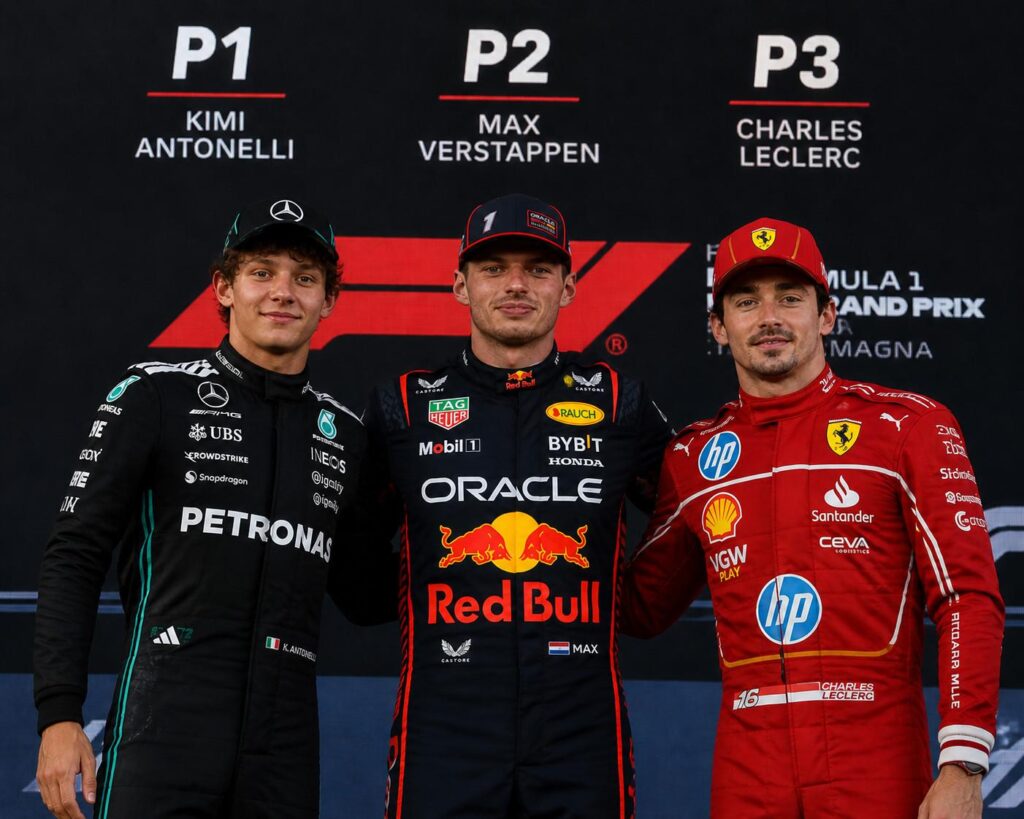
If there were any remaining doubts about Kimi Antonelli’s status as the new gravitational center of the Formula 1 paddock, they were silenced in Q3. By securing his third consecutive Grand Prix pole position, Antonelli didn’t just beat the field; he dismantled it. His initial benchmark of 1:27.7 was a “step forward” so massive it felt like a generational shift, leaving a talent as formidable as Charles Leclerc a staggering three-tenths of a second adrift before the final runs.
Antonelli’s dominance across both the sprint and Grand Prix formats suggests a driver who has mastered the “compliance” of the Mercedes chassis better than his veteran teammate. While others fought the car through the technical Sector 2, Antonelli looked like he was on rails. As the commentary booth aptly noted:
“When it comes to Grand Prix qualifying, Kimi Antonelli is showing the Formula 1 field the way at the moment.”
The Champion’s Tightrope: Oscar Piastri’s Q1 Near-Disaster
The unpredictability of the Miami asphalt was best personified by last year’s winner, Oscar Piastri. In a Q1 session that can only be described as “sweaty,” the McLaren driver found himself staring down the barrel of an almighty shock elimination. As the clock wound down, Piastri sat in 11th, his lap time vulnerable to a late-session surge from the likes of Arvid Lindblad and Esteban Ocon.
The margin between survival and a catastrophic early exit was a razor-thin 900ths of a second (0.009s). While Piastri managed to scrape into the later segments, his day never truly recovered. In Q3, the Australian struggled with the crucial nuances of energy deployment—a factor the commentators highlighted as the difference between the front row and the mid-pack. Ultimately, finishing 0.7 seconds off Antonelli’s pace served as a sobering reminder of how unforgiving the 2026 machines are when the setup isn’t singing.
Verstappen’s Late-Session Resurrection
For much of the afternoon, Max Verstappen and Red Bull appeared to be mired in the “doldrums.” After a five-week break, the RB22 seemed to lack the visceral snap required to challenge the Mercedes and Ferraris. Verstappen spent the better part of Q3 in third, looking like a man resigned to a second-row start.
However, Verstappen’s genius has always been his ability to find lap time when the track is at its most temperamental. In his final flyer, he delivered a masterclass in the final sector, hanging onto the car as he applied the power to climb into P2. He snatched a front-row start by eclipsing Lando Norris’s McLaren by a microscopic 2,000ths of a second (0.002s). The explosion of relief on the radio spoke volumes about the pressure within the Red Bull garage:
“Let’s go man! Woo! Ah, feels good man. Feels good, thank you.”
Technical Gremlins and Veteran Struggles
The 2026 Miami qualifying session was a brutal reminder that experience doesn’t always trump technical volatility. The “business end” of the session saw several veterans struggling to adapt to the rapid track evolution and the sheer physical toll of the 2026 aero packages.
- Charles Leclerc: Despite his raw pace, the Ferrari driver faced a frantic Q1 when he reported “brakes on fire,” forcing his mechanics into a high-pressure patch-up job just to keep him in the hunt.
- The Seven-Time Champion’s Innovation: Lewis Hamilton’s Ferraris was seen utilizing a “rotating rear wing element”—a centerpiece of the 2026 active aero regulations—to find compliance in the middle sector. While it assisted his balance, he still found himself unable to match the younger Antonelli’s final sector surge.
- Fernando Alonso: The Spaniard’s session was a nightmare of flat-spotted tires and “burning rubber” under acceleration. The Aston Martin simply lacked the fundamental pace, leaving Alonso frustrated as he limped back to the pits, out in the early stages.
- The Second-Seat Syndrome: Sergio Perez found himself on the wrong side of the delta once again, outqualified by Valtteri Bottas, highlighting the massive performance variance between the top-tier machinery and the midfield when the setup is sub-optimal.
The Changing Guard: A Midfield in Flux
The 2026 hierarchy has solidified into a “Top 5” lockout, with Alpine, Red Bull, McLaren, Mercedes, and Ferrari creating a barricade that the rest of the grid cannot breach. This left a “gaggle” of talented drivers including Nico Hulkenberg, Liam Lawson, Oliver Bearman, and Alex Albon fighting for the scraps.
The intensity of the margins was best illustrated when Albon’s Williams nearly knocked the world champion, Lando Norris, into the drop zone during the session. It was a moment that proved even the elite are only one minor energy-deployment error away from disaster. While Lawson (P12) and Bearman (P13) showed flashes of brilliance, they were ultimately spectators to the five-manufacturer war for pole.
Conclusion: A Grid Primed for Chaos
As the Miami sun begins to set, the grid is balanced on a knife-edge. Kimi Antonelli has the momentum, but Max Verstappen has the resurgence. With the 2026 regulations making the cars more sensitive to energy management and “dirty air” than ever before, the run to Turn 1 will be a masterclass in tactical aggression.
Can Antonelli convert this pole into a win and solidify his status as the new king of qualifying? Or will Verstappen’s late-session heroics provide the platform for a Red Bull comeback? On a circuit this mercurial, the only certainty is that the 2026 technical regulations have delivered exactly what they promised: a field separated by thousandths, where the smallest mistake can set the world on fire.
Discover Popular Updates :-
Norris Topples Mercedes in High-Stakes Miami Sprint Qualifying
2026 Formula 1 Super Licence Prices From Norris to Colapinto
Formula 1 2026: A Deep Dive Into the Radical New Era
F1 Stats Last Updated: May 3, 2026 | All statistics, lap times, and driver comparisons on this page reflect the most current data available from the official F1 sources. And updated till the last race which happened in 3 May 2026